ENGLISH
 English
 简体中文
简体中文 Русский
 日本語
日本語 España
 Portugal
What is a Power Control Module? Definition, Applications, and Benefits
What is a power control module?
A power control module (PCM) is an integrated electronic unit that monitors, regulates, and distributes electrical energy to multiple loads.
It combines voltage regulation, current limiting, protection, and intelligent switching to ensure each subsystem receives stable power under varying conditions.
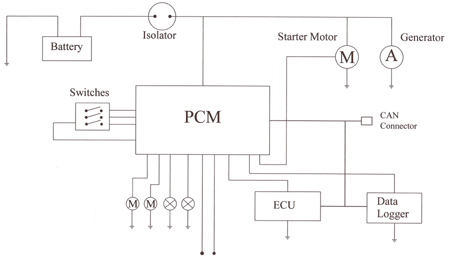
Functions
Voltage regulation to keep outputs within tight tolerances.
Current management via limiting, soft-start, and load prioritization.
Protection against overvoltage, overcurrent, short-circuit, reverse polarity, and thermal events.
Intelligent switching & sequencing for safe, coordinated power-up/down.
Diagnostics & communication (e.g., I²C, CAN, UART) for status, telemetry, and fault codes.
Typical building blocks
DC/DC stages (buck, boost, buck-boost) or AC/DC front ends
High-side/low-side power switches and gate drivers
Sense circuitry (voltage, current, temperature)
Controller/MCU with firmware for policies and protection
Thermal management (heatsinks, pads, airflow paths)
How a power control module works?
The PCM accepts one or more inputs (battery, adapter, rectified AC, or DC bus) and conditions them through conversion stages. It then allocates power to downstream rails using policy rules—such as load priority, inrush limits, and brownout recovery. Feedback loops maintain regulation while protection logic isolates faults and records diagnostics for maintenance.
Tip: When multiple high-inrush loads start simultaneously, a sequenced enable strategy in the power control module reduces stress on upstream supplies and wiring harnesses.
Applications
Automotive electronics
In vehicles, a power control module distributes energy to ECUs, lighting, ADAS sensors, infotainment, and pumps/fans. It coordinates with engine and transmission controllers but remains focused on electrical power integrity and protection.
Industrial automation
Drives, robotics, PLC cabinets, and process tools rely on PCMs for stable DC buses, motor protection, and minimized downtime via predictive diagnostics.
Consumer & IoT devices
From laptops to smart appliances, the PCM manages charging profiles, standby power, and safety cutoffs—extending battery life and user safety.
Renewable energy systems
Solar inverters and wind converters use power control modules to optimize conversion efficiency, grid compliance, and fault isolation.
Benefits of a power control module
Energy efficiency: high conversion efficiency and lower system losses.
Reliability: robust protection and thermal design reduce failures.
Serviceability: embedded diagnostics simplify troubleshooting and uptime planning.
Scalability: modular rails and policies adapt to evolving load profiles.
Safety & compliance: easier certification with integrated protection features.
Quick selection checklist
Input/output ranges: Match voltage and peak/continuous current with margin.
Protection set: OVP, OCP, OTP, SCP, reverse polarity; adjustable thresholds preferred.
Thermal path: Heatsink options, copper area, airflow; verify worst-case junction temps.
Control & comms: Analog vs. digital; need for telemetry (I²C/CAN/UART) and logging.
Environment: Temperature, vibration, ingress (e.g., IP ratings), EMC/EMI limits.
Compliance: Automotive (AEC-Q100/Q200), industrial, or safety standards as required.
FAQ
Is a power control module just a voltage regulator?
No. While regulation is central, a PCM adds protection, intelligent switching, sequencing, telemetry, and often multi-rail orchestration.
Can a PCM improve battery life?
Yes. By optimizing conversion efficiency, limiting inrush, and managing sleep/standby states, a power control module reduces wasted energy.
What signals can a PCM report?
Typical telemetry includes rail voltages/currents, temperature, fault codes, and event logs for predictive maintenance.