ENGLISH
 English
 简体中文
简体中文 Русский
 日本語
日本語 España
 Portugal
IGBT Module for Variable Frequency Drives
IGBT Module for Variable Frequency Drives: Selection Guide for Industrial
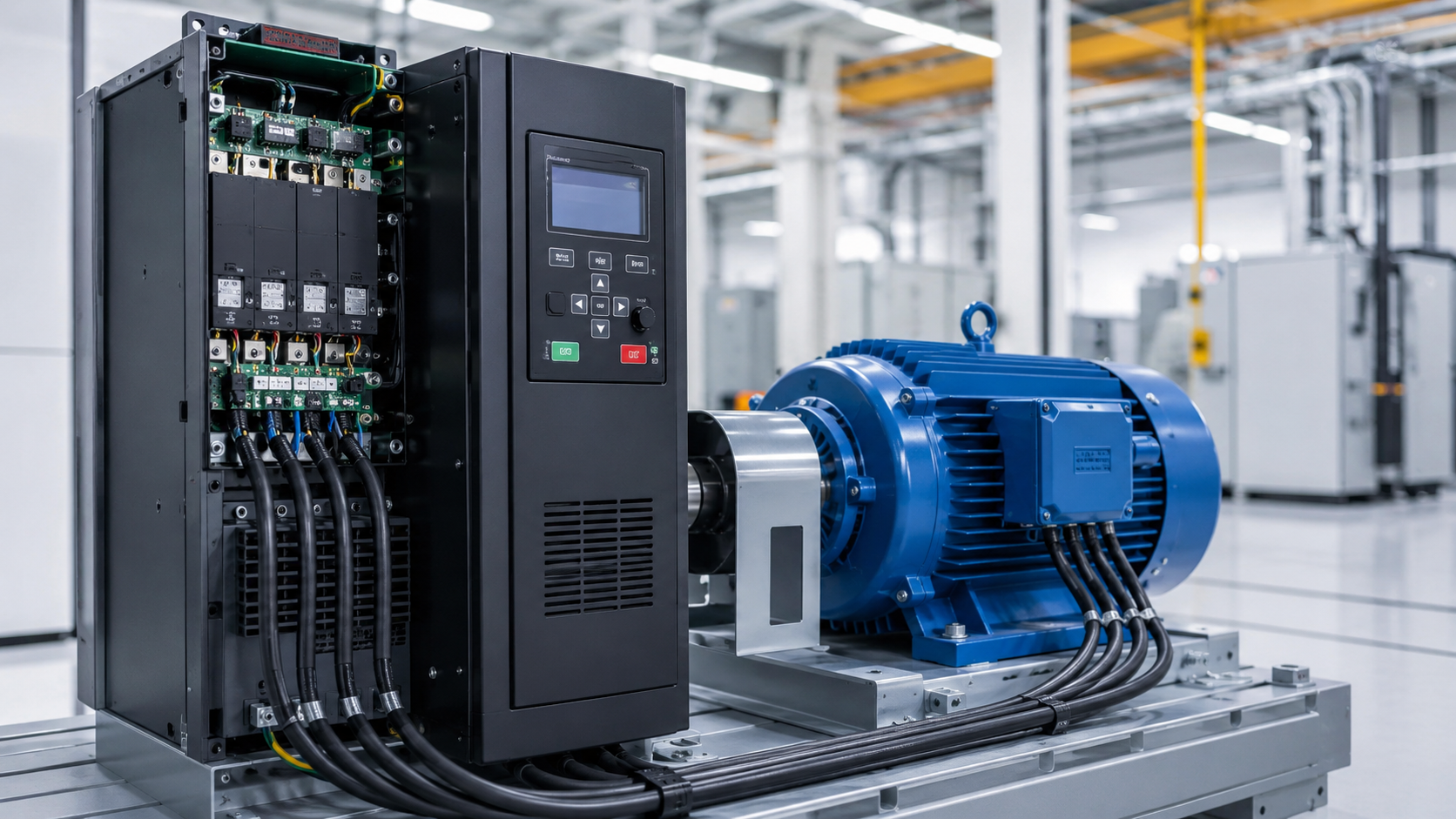
Motor Drive Applications
Variable Frequency Drives, also known as VFDs, are widely used in industrial motor control systems. They help control motor speed, reduce energy consumption, improve process stability, and protect mechanical equipment from unnecessary stress.
Learn how to choose the right IGBT module for variable frequency drives. This guide covers voltage rating, current rating, thermal design, switching loss, failure causes, and supplier selection for VFD manufacturers.
In a VFD system, the IGBT module is one of the most critical power semiconductor components. It directly affects system efficiency, switching performance, thermal reliability, and long-term service life.
For VFD manufacturers, choosing the right IGBT module is not only a component selection decision. It is a system reliability decision.
This guide explains how to select a suitable IGBT module for variable frequency drives and what engineers should evaluate before sample testing or mass production.
1. What Is an IGBT Module?
An IGBT module is a power semiconductor module that integrates multiple IGBT chips, freewheeling diodes, terminals, insulation materials, and a heat dissipation structure into one package.
IGBT means Insulated Gate Bipolar Transistor. It combines the easy gate control of a MOSFET with the high-current capability of a bipolar transistor.
In industrial applications, IGBT modules are commonly used in:
Variable frequency drives
Servo drives
UPS systems
Solar inverters
Welding machines
Energy storage systems
Industrial power supplies
EV chargers
For VFD applications, IGBT modules are mainly used in the inverter stage to convert DC bus voltage into controlled AC output for three-phase motors.
2. Why Are IGBT Modules Used in Variable Frequency Drives?
A variable frequency drive controls motor speed by adjusting output frequency and voltage. The power stage of a VFD usually includes three main sections:
Rectifier stage
DC link stage
Inverter stage
The IGBT module works in the inverter stage. It switches at high speed and generates PWM output to control the motor.
IGBT modules are preferred in VFD systems because they offer:
High voltage capability
Strong current handling capability
Good switching performance
Mature and reliable technology
Cost-effective performance for medium and high-power drives
Easy integration into industrial power systems
For many industrial motor drive applications, IGBT modules provide a good balance between efficiency, reliability, and cost.
3. Key Parameters for IGBT Module Selection
When choosing an IGBT module for a VFD, engineers should not only compare the voltage and current rating. A complete selection process should include electrical, thermal, mechanical, and application-level evaluation.
The most important parameters include:
Voltage rating
Current rating
VCE(sat)
Switching loss
Thermal resistance
Isolation voltage
Short-circuit withstand capability
Package type
Mounting method
Terminal layout
Gate drive requirement
Cooling condition
Each parameter affects system performance and reliability.
4. Voltage Rating Selection
Voltage rating is one of the first parameters to evaluate.
For many industrial VFD systems using 380V or 400V AC input, 1200V IGBT modules are commonly selected. This is because the DC bus voltage is higher than the AC input voltage, and the system also needs margin for transient voltage spikes.
Typical selection examples:
| VFD System | Common IGBT Voltage Rating |
|---|---|
| Low-voltage drive system | 600V |
| 380V / 400V industrial VFD | 1200V |
| Higher-voltage industrial drive | 1700V |
The key point is that engineers should not only consider normal operating voltage. They should also consider DC bus voltage, switching transients, overvoltage protection, and application environment.
A suitable voltage margin can help reduce the risk of breakdown and improve long-term reliability.
5. Current Rating Selection
Current rating should be selected based on motor power, output current, overload requirement, switching frequency, cooling design, and ambient temperature.
In VFD applications, the IGBT module must withstand both continuous current and short-term overload conditions.
Engineers should evaluate:
Motor rated power
Rated output current
Peak current
Overload capability
Duty cycle
Cooling method
Heat sink design
Ambient temperature
Installation environment
An undersized IGBT module may reduce initial cost, but it can increase the risk of overheating, shutdown, or premature failure.
A properly selected IGBT module should provide enough current margin for real working conditions.
6. Switching Loss and Conduction Loss
Power loss is a key factor in VFD design.
The total loss of an IGBT module mainly includes:
Conduction loss
Switching loss
Conduction loss is related to current and VCE(sat). Switching loss is related to voltage, current, switching frequency, and gate drive conditions.
In general:
Higher switching frequency can improve motor control performance.
Higher switching frequency also increases switching loss.
Lower loss helps reduce heat generation.
Better thermal design improves module lifetime.
For VFD engineers, the goal is to balance efficiency, thermal performance, acoustic noise, and motor control quality.
7. Thermal Management in VFD Applications
Thermal design is critical for IGBT module reliability.
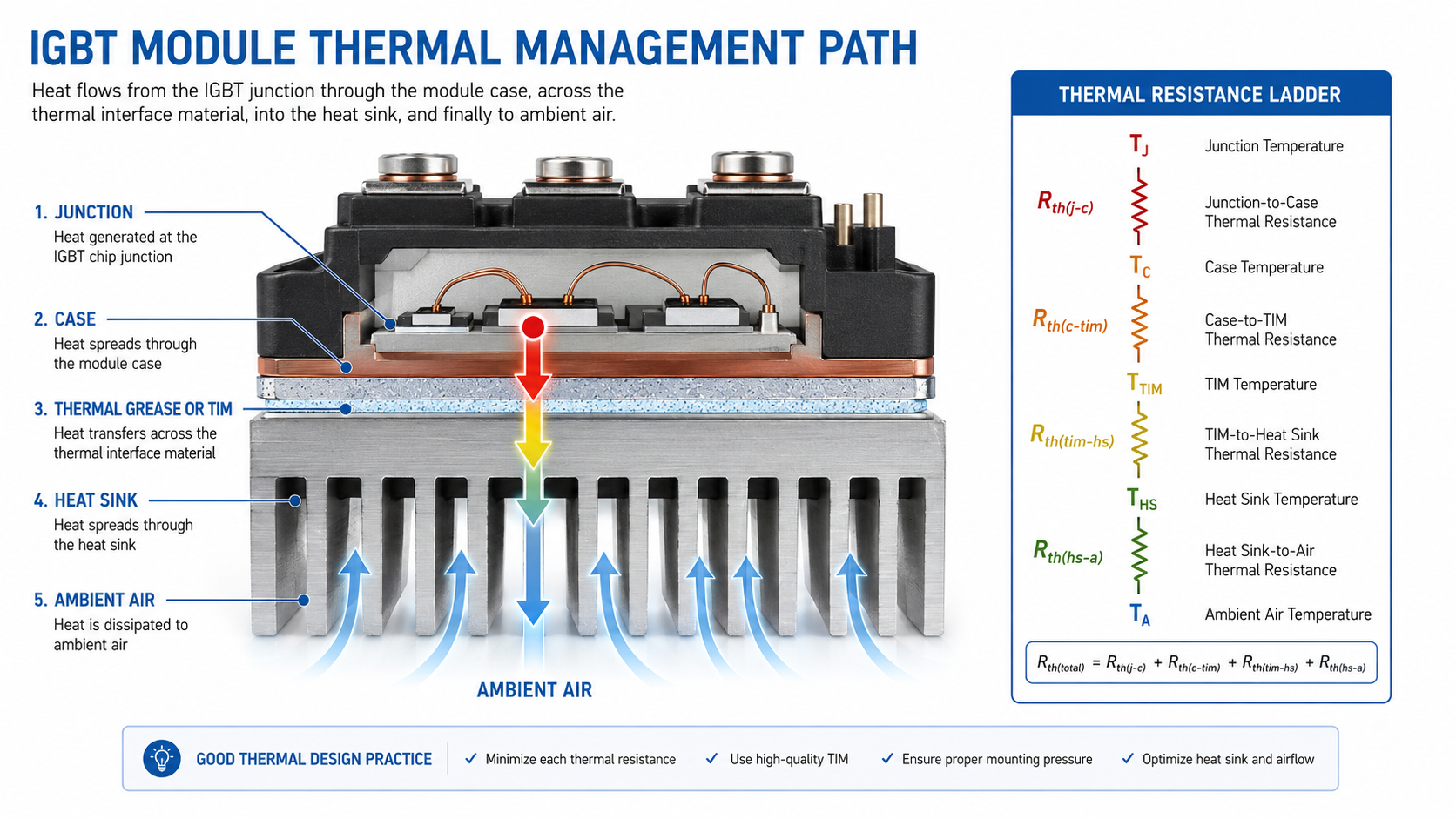
The heat generated inside the IGBT chip must transfer through several layers:
Junction → Case → Thermal Interface Material → Heat Sink → Air
If the thermal path is not well designed, the junction temperature may become too high. High junction temperature can accelerate aging and reduce the module lifetime.
Common thermal design problems include:
Insufficient heat sink size
Uneven thermal grease application
Poor mounting pressure
Loose screws
Poor air cooling
High ambient temperature
Dust or blocked airflow
For VFD manufacturers, thermal design should be verified before mass production.
Good thermal management can reduce failure risk and improve long-term field performance.
8. Short-Circuit and Overcurrent Protection
VFD systems may face abnormal operating conditions such as motor stall, sudden load change, output short circuit, or overcurrent.
Therefore, short-circuit withstand capability is an important parameter for IGBT modules used in motor drives.
However, module capability alone is not enough. The gate driver and protection circuit must detect faults quickly and turn off the IGBT safely.
A complete protection design should consider:
Short-circuit detection
Overcurrent protection
Overvoltage protection
Gate resistance optimization
Desaturation protection
Temperature monitoring
DC bus protection
Reliable IGBT module performance depends on both the module and the system design.
9. Mechanical Compatibility and Package Selection
Mechanical compatibility is important, especially when replacing an existing IGBT module from another supplier.
Engineers should check:
Package dimensions
Mounting hole position
Terminal layout
Terminal height
Gate terminal position
Heat sink contact area
Insulation structure
Busbar compatibility
If the package is compatible, the customer can reduce redesign time and accelerate sample testing.
For VFD manufacturers looking for a second-source IGBT module supplier, mechanical compatibility is often a key factor.
10. Common IGBT Module Failure Causes in VFD Systems
IGBT module failure is often caused by system-level issues, not only by the module itself.
Common failure causes include:
Overheating
Overcurrent
Overvoltage
Poor thermal contact
Incorrect gate drive design
Insufficient protection circuit
Loose mounting screws
Unstable DC bus
Harsh operating environment
Wrong module selection
Before replacing a failed IGBT module, engineers should analyze the real failure cause. Otherwise, the same failure may happen again even after changing suppliers.
11. How to Choose an IGBT Module Supplier for VFD Applications
For VFD manufacturers, selecting an IGBT module supplier is not only about price.
A reliable supplier should provide:
Stable product quality
Complete datasheets
Model selection support
Cross-reference recommendation
Sample support
Technical communication
Stable delivery
Long-term supply capability
Cost-effective alternatives
Many VFD manufacturers already use international brands, but they still need reliable second-source suppliers to reduce supply chain risk and improve cost competitiveness.
A strong IGBT module supplier should help customers reduce risk, not only reduce cost.
12. Conclusion
The IGBT module is a core power semiconductor component in variable frequency drives.
For VFD applications, engineers should evaluate voltage rating, current rating, switching loss, conduction loss, thermal resistance, short-circuit capability, package compatibility, and supplier support.
A suitable IGBT module can help improve VFD efficiency, reduce failure risk, and extend system lifetime.
If you are developing or manufacturing VFDs, motor drives, pump drives, fan drives, compressor drives, HVAC drives, or industrial automation systems, we can support your IGBT module selection.
Send us your motor power, input voltage, output current, switching frequency, and application conditions. Our team will help recommend a suitable IGBT module solution for your project.
FAQ
What is the best IGBT module for a variable frequency drive?
The best IGBT module depends on input voltage, motor power, output current, switching frequency, cooling design, overload requirement, and package compatibility.
Why do VFDs use IGBT modules?
VFDs use IGBT modules because they provide a good balance of voltage capability, current handling, switching performance, reliability, and cost for industrial motor drive applications.
Is a 1200V IGBT module suitable for a 380V or 400V VFD?
For many 380V or 400V industrial VFD systems, 1200V IGBT modules are commonly used because they provide enough voltage margin for DC bus voltage and transient spikes.
What causes IGBT module failure in VFD systems?
Common causes include overheating, overcurrent, overvoltage, poor thermal contact, incorrect gate drive, insufficient protection design, loose mounting, and unsuitable module selection.
How can VFD manufacturers choose a second-source IGBT module supplier?
They should check electrical parameters, mechanical compatibility, thermal performance, sample support, datasheet quality, delivery stability, and technical response capability.