ENGLISH
 English
 简体中文
简体中文 Русский
 日本語
日本語 España
 Portugal
What is the Function of a Diode? Explained with Examples
Diode Overview
At its core, a diode’s function is to allow current to flow in one direction (forward bias) and block it in the other (reverse bias). This simple behavior enables key tasks across power, signal, and protection circuits.
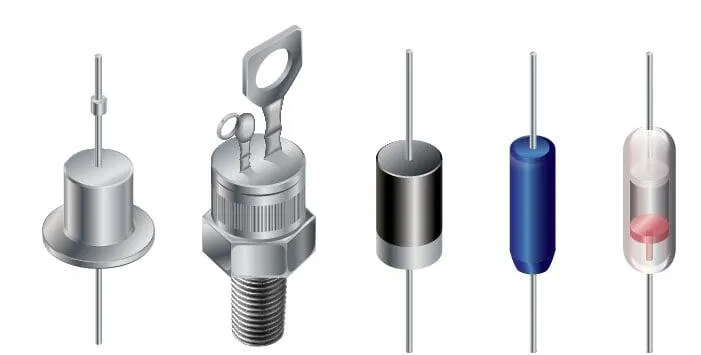
What Does a Diode Do?
Diodes have polarity, determined by an anode (positive lead) and cathode (negative lead). Most diodes allow current to flow only when positive voltage is applied to the anode.
When a diode allows current flow, it is forward-biased. When a diode is reverse-biased, it acts as an insulator and does not permit current to flow.
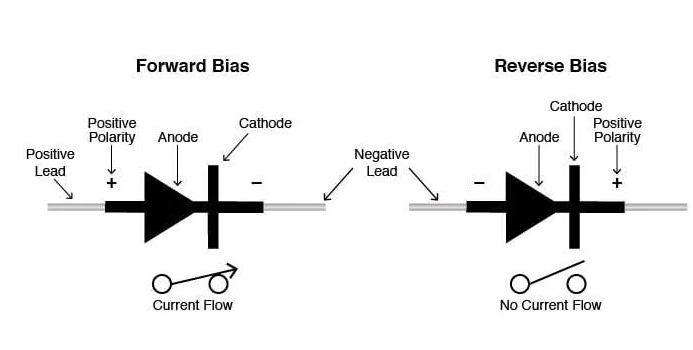
Strange but true: The diode symbol's arrow points against the direction of electron flow. The reason is that engineers conceived the symbol, and their schematics show current flowing from the positive (+) side of the voltage source to the negative (-). It's the same convention used for semiconductor symbols that include arrows — the arrow points in the permitted direction of "conventional" flow, and against the permitted direction of electron flow.
Main functions of a diode
1) Rectification (AC → DC)
Diodes form half-wave and full-wave bridge rectifiers that convert AC to DC—the heart of chargers and power supplies.
2) Voltage regulation
Zener diodes provide a stable reference in reverse breakdown, enabling simple regulators and overvoltage clamps.
3) Reverse-polarity protection
Series or shunt diodes protect devices if supply polarity is accidentally reversed, common in automotive and adapters.
4) Signal demodulation & detection
Small-signal diodes recover baseband audio/data from RF carriers in radios and communication receivers.
5) High-speed switching & mixing
Schottky or fast diodes handle high-frequency switching in SMPS and RF mixers with minimal loss.
6) Light emission & sensing
LEDs emit light under forward bias; photodiodes convert light into current for sensing and energy harvesting.
Common diode types & what they do
| Diode type | Function / Typical use | Notes |
|---|---|---|
| Standard PN diode | Rectification, blocking reverse current | ~0.6–0.7 V forward drop (Si) |
| Schottky diode | High-efficiency rectification, fast switching | ~0.2–0.4 V drop, low reverse voltage ratings |
| Zener diode | Voltage reference/regulation, surge clamp | Operates in reverse breakdown region |
| Fast/ultrafast diode | SMPS, motor drives, high-frequency rectifiers | Short reverse-recovery time |
| LED (light-emitting diode) | Indicators, displays, general lighting | Light output vs. current/temperature matters |
| Photodiode | Light sensing, optical comms, solar cells | Current proportional to incident light |
| Varactor (varicap) | Voltage-controlled capacitance (RF tuning) | Used in VCOs, PLLs, RF filters |
See also: How to check diode with multimeter · Bridge rectifier basics · Zener diode regulation
Why diodes matter
Power conversion: Enable reliable AC/DC adapters and DC/DC stages.
Protection & reliability: Guard against reverse polarity and overvoltage.
Efficiency: Schottky and fast devices reduce losses in modern power supplies.
Signal integrity: Crucial in detection, mixing, and RF front-ends.
FAQ
Is a diode a resistor?
No. A diode is a nonlinear semiconductor device; its I-V curve depends on junction physics, not a constant resistance.
Can a diode increase voltage?
Not by itself. Diodes can be used in multiplier circuits with capacitors to step up voltage from AC sources.
What fails most often in diodes?
Overcurrent and overheating can cause shorted junctions; excessive reverse voltage can cause breakdown and leakage or open failure.